
Your Questions Are More Interesting Than Our Answers

A moment at the Lahore Literary Festival has stayed with me.
During a public discussion involving journalist Roger Cohen, an audience member held on to the microphone and continued with a chain of questions as the session approached its end. The room was growing tense. The moderator closed the exchange with a line I have remembered ever since:
“Your questions are more interesting than our answers. Ciao.”
It was an eight-word compliment followed by a one-word farewell. Warm, firm and unforgettable.
Why Do People Hold On to the Microphone?
Rarely is it because they want to be rude. More often, they are carrying something that matters to them: a conviction, a worry or a grievance. They fear that if they let go, no one will take it seriously. So they hold on tighter.
William James once admitted this with charm. At Easter in 1896, his students at Radcliffe College sent him a potted azalea. Touched, he wrote back to confess that his famous book on psychology had left something out. He now saw that “the deepest principle of Human Nature is the craving to be appreciated.”
What did the moderator’s words give the questioner? Appreciation, offered generously and in front of everyone. Once a person feels truly heard, there is little reason left to keep holding on.
Someone who repeats the same point is like a courier ringing a doorbell. The ringing stops when somebody signs for the parcel.
That is the real power of engaging dialogue. It is not two monologues taking turns. It is a promise that what you say will be received. As I remember the moment, Cohen met the questioner head-on rather than looking away. The moderator completed the exchange by letting the questioner know that the questions had landed.
Principle 1: Make people feel heard, and they will gladly hand back the microphone.
Lesson Two: Treat Every Question as a Gift
There is a second lesson in that sentence, and it may be the more important one. The moderator did not call the questions too long or off-topic. The questions were praised as more interesting than the answers.
Most of us were raised the other way around. At school, the right answer earned the gold star, while the child with too many questions was told to wait until the end. We learned to treat answers as treasure and questions as interruptions.
Isidor Rabi grew up in an immigrant family in New York and won the Nobel Prize in Physics in 1944. His work on magnetic resonance helped establish principles later used in nuclear magnetic resonance and MRI. When asked what made him a scientist, Rabi credited his mother. Other parents, he recalled, asked their children what they had learned that day. His mother asked something else:
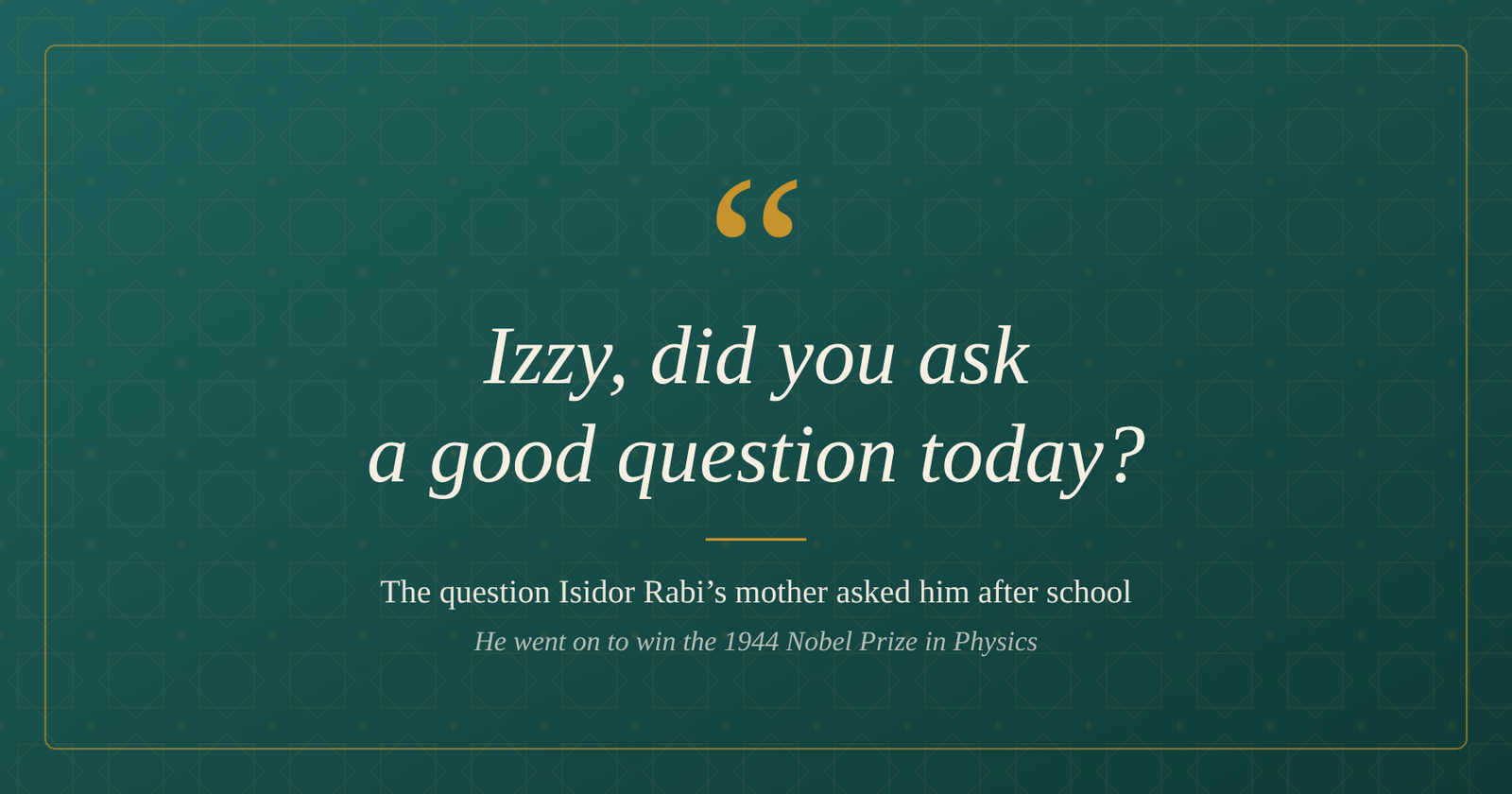
That small daily question, Rabi said, helped make him a scientist.
In my own work as a researcher, I have found the same thing. Answers, when they finally arrive, are satisfying. But the work always begins with a question that will not leave you alone.
More than two centuries ago, the French writer Pierre-Marc-Gaston, duc de Lévis, made a similar point in Maximes et réflexions: it is easier to judge a person’s mind by their questions than by their answers. The line is often credited to Voltaire, but it belongs to Lévis. That proves the point rather nicely: a good question—Who really said that?—is often worth more than a confident answer.
The questioner in Lahore may have overstayed the welcome. Underneath it, however, was something precious: curiosity. The moderator protected that curiosity while still closing the session. That is the difference between managing a room and leading one.
Principle 2: Treat every question as a gift, even the inconvenient ones.
Lesson Three: Close the Conversation, Not the Door
Now we come to the hardest skill: handling a tense, complicated or controversial moment in public, with every eye in the room on you.
When one person dominates a conversation, there are four broad responses. It helps to picture them on a simple grid, with warmth on one axis and firmness on the other.
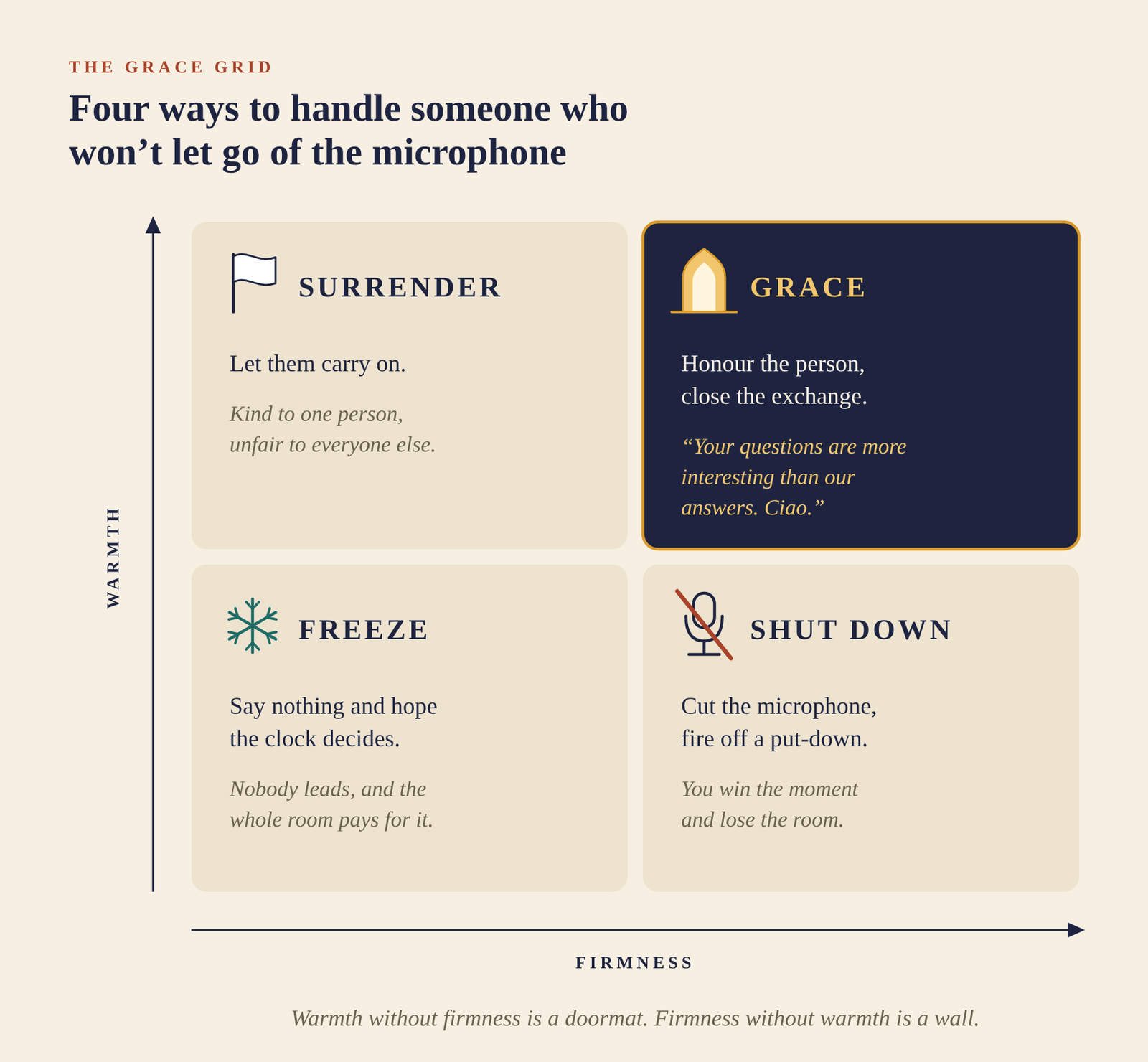
You can surrender and let them continue. That is kind to one person and unfair to everyone else. You can freeze and hope the clock solves the problem. It rarely does. You can shut them down: cut the microphone or fire off a put-down. You may win the moment but lose the room, because people tend to side with anyone they see humiliated.
Or you can choose grace: honour the person and close the exchange in the same breath. That is what the moderator in Lahore did.
Grace needs both warmth and firmness. Warmth without firmness becomes a doormat. Firmness without warmth becomes a wall. Put the two together and you get something rare: a boundary that feels like a compliment.
Dale Carnegie had a rule for exactly this kind of moment: let the other person save face. The questioner was not defeated in front of the crowd, but praised in front of it. And because ciao means hello as well as goodbye, the conversation closed while the door stayed open.
Principle 3: When you must close a conversation, close it with a compliment.
How to Use This Tomorrow Morning
You may never moderate a panel in Lahore. But you will meet the person who will not let go of the microphone. They may appear in your Monday meeting, classroom, family group chat or at the dinner table. Here is how to bring grace into the room.
- Listen for the need beneath the words. Ask what the person really wants. Usually, it is to be taken seriously.
- Name what is valuable, sincerely. Find the genuine merit in the point and say it aloud. Flattery is counterfeit, and people can tell.
- Step down a step. A touch of humility—“You have raised more than we can answer today”—lets the other person step back without losing face.
- Close clearly and kindly. Do not apologise for ending. A warm, unmistakable full stop is a gift to everyone in the room.
- Leave the door open. Offer a practical next step: a conversation after the session, an email or a coffee.
A Few Sentences You Can Borrow
- “You have given us more to think about than we can answer in the time we have.”
- “That deserves a better answer than I can give in thirty seconds. Can we talk afterwards?”
- “I want to make room for a few more voices, so let me pause us here. Thank you for starting this.”
- “That is a question I will be thinking about on the drive home.”
Or, if you have the nerve, the original: “Your questions are more interesting than our answers. Ciao.”
In a Nutshell
How to close a conversation without closing the door:
- Principle 1: Make people feel heard, and they will gladly hand back the microphone.
- Principle 2: Treat every question as a gift, even the inconvenient ones.
- Principle 3: When you must close a conversation, close it with a compliment.
Many eloquent things were said on that stage in Lahore. The words that stayed with me were the compliment and farewell spoken at the end. Answers fade. Questions—and the way we treat the people who ask them—stay with us.
So tonight, before you sleep, ask yourself the question Isidor Rabi’s mother asked him: Did I ask a good question today? And tomorrow, when someone grips the microphone a little too tightly, remember the moderator in Lahore.
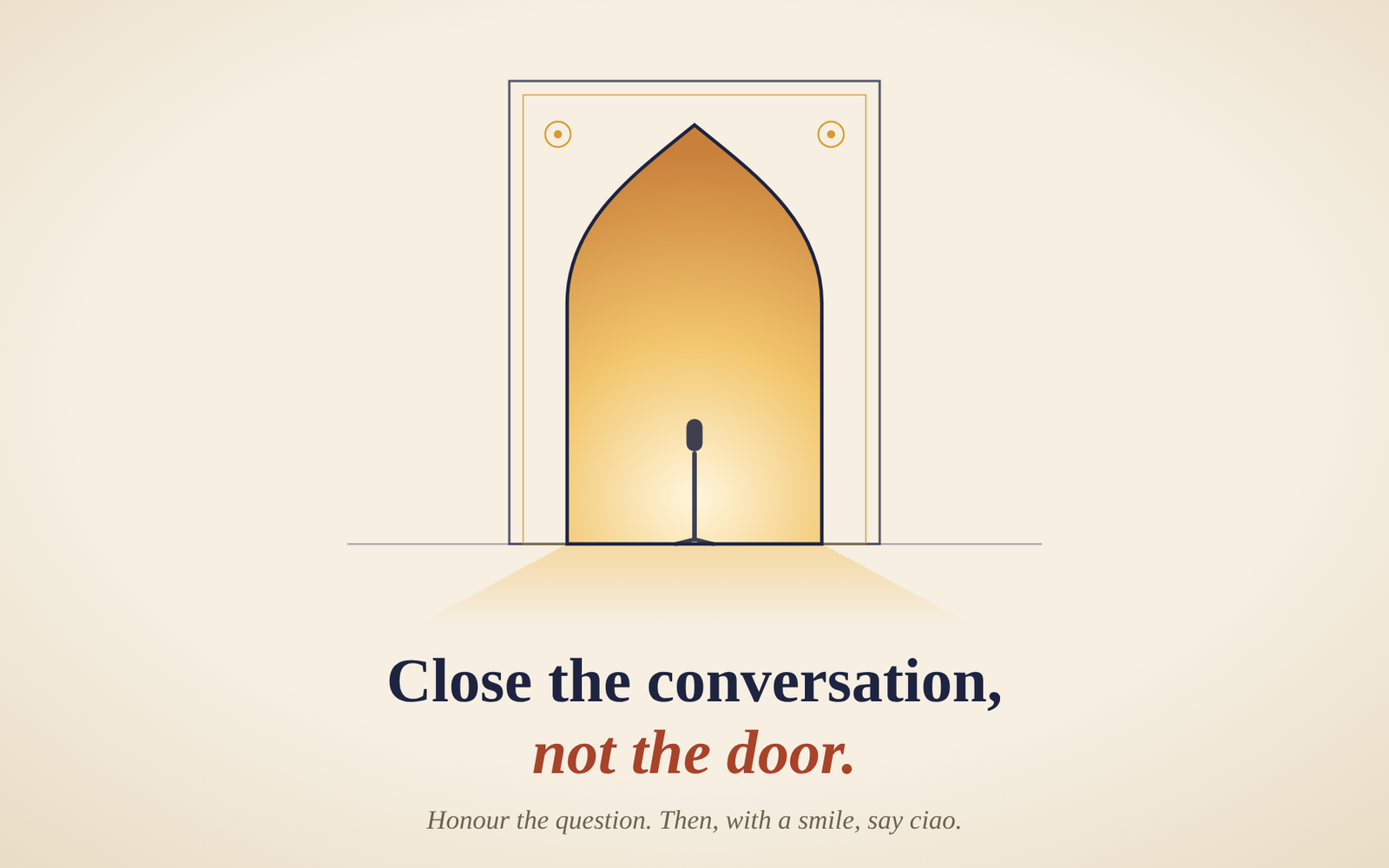
Honour the question. Then, with a smile, say ciao.
Sources and Note
- William James, letter to Radcliffe Philosophy 2A, 6 April 1896, on the human craving to be appreciated.
- Isidor I. Rabi received the 1944 Nobel Prize in Physics for his resonance method; the story about his mother’s daily question has been widely preserved in educational accounts of his life.
- The maxim about judging a mind by its questions is attributed to Pierre-Marc-Gaston, duc de Lévis, Maximes et réflexions (1808), not Voltaire.
The Lahore episode is presented as a personal recollection rather than a verbatim transcript.