
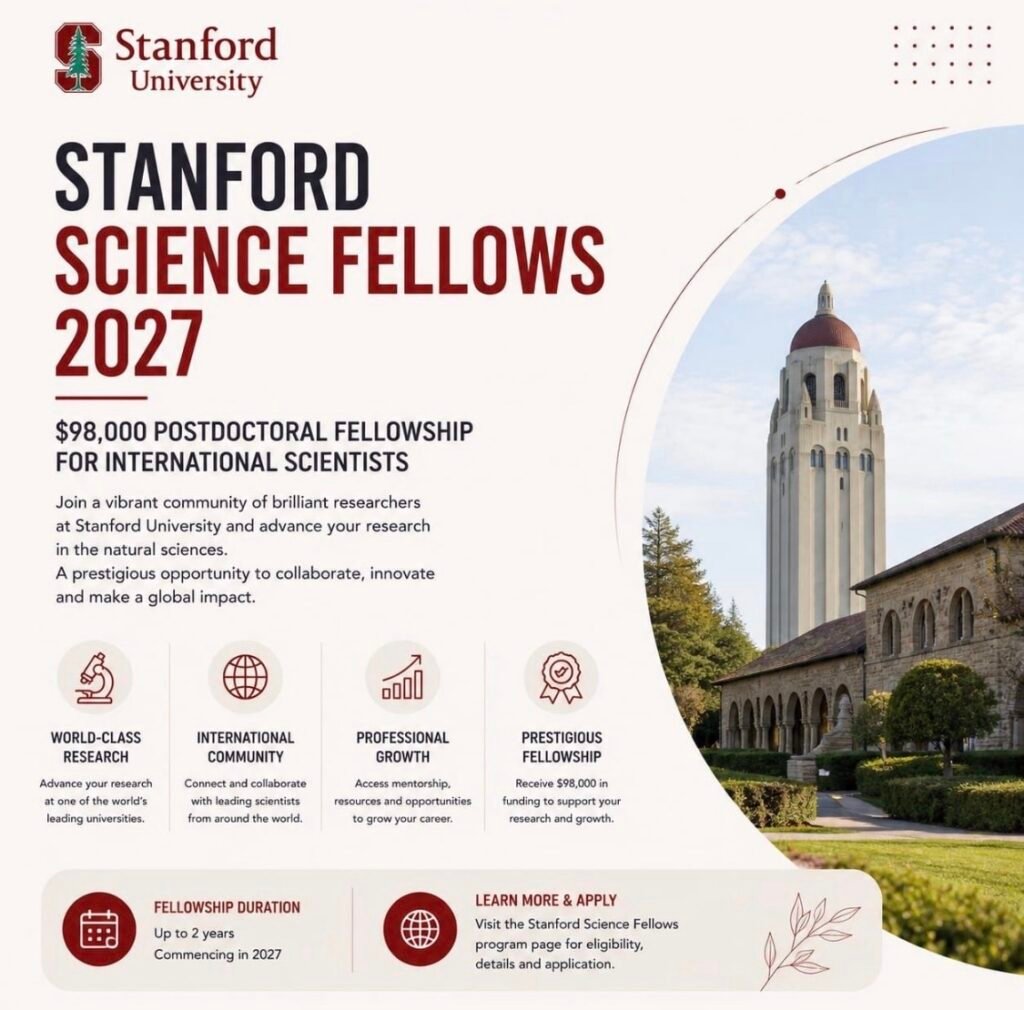
Stanford Science Fellows 2027
A fellowship designed for early-career scientists who want to pursue bold questions, cross disciplinary boundaries and help shape the future of foundational research.
Some of the most important scientific questions do not sit neatly within one field. They emerge where physics meets biology, where mathematics informs medicine, or where engineering tools reveal new aspects of the natural world. The Stanford Science Fellows programme embraces precisely this kind of intellectual overlap.
Bringing together postdoctoral scholars from around the world, the programme creates an interdisciplinary community united by curiosity and a desire to explore new directions in foundational science. Its focus extends beyond completing a defined research project. It gives promising scientists the freedom, resources and support to develop an independent research vision.
A Fellowship Built Around Scientific Curiosity
At its heart, the Stanford Science Fellows programme aims to deepen our understanding of the natural world. It encourages researchers to advance their own disciplines while building meaningful connections across the physical, mathematical and life sciences.
This approach reflects a growing reality in modern research: major breakthroughs often occur when scientists bring together methods, perspectives and evidence from several fields. By reducing conventional disciplinary barriers, the fellowship allows researchers to follow the scientific question wherever it leads.
Five Ambitions Behind the Programme
The programme centres on five broad ambitions:
1. Advance foundational knowledge. Fellows investigate fundamental scientific questions and build bridges between related disciplines.
2. Develop scientific leaders. The fellowship helps early-career researchers strengthen their academic leadership, interdisciplinary thinking and ability to foster discovery.
3. Broaden participation in science. It recognises the value of varied perspectives, experiences and backgrounds, including those historically underrepresented in scientific fields.
4. Build a frontier-research community. Fellows connect with researchers across Stanford who are working on complex and emerging scientific challenges.
5. Support intellectual independence. The programme gives bold thinkers the flexibility and resources to pursue original research ideas rather than confining them to a narrowly prescribed agenda.
Together, these ambitions position the fellowship as both a research opportunity and a platform for long-term academic growth.
Research Across Stanford’s Scientific Ecosystem
Stanford Science Fellows can work with multiple faculty members and access facilities across the university’s Schools of Humanities and Sciences, Engineering, Medicine, and Sustainability. They may also engage with the specialised research environment of the SLAC National Accelerator Laboratory.
This breadth matters. A fellow investigating an emerging scientific problem may need advanced experimental facilities, computational expertise, mathematical insight or collaboration with researchers in a neighbouring discipline. Access to this wider ecosystem makes genuinely interdisciplinary work more achievable.
Mentorship Without Losing Independence
A cross-disciplinary faculty committee selects the fellows and continues to support them throughout the fellowship. Regular engagement with faculty provides mentorship, intellectual guidance and practical assistance while fellows establish their own research direction.
This balance is particularly valuable during the postdoctoral stage. Early-career researchers need room to become independent, but they also benefit from trusted mentors who can challenge their assumptions, introduce new perspectives and help them navigate the transition towards scientific leadership.
Building Community, Leadership and Communication Skills
Scientific impact depends on more than technical ability. Researchers must also explain complex ideas clearly, collaborate across different fields and create environments in which other people can contribute effectively.
The programme therefore includes workshops, seminars, informal gatherings and discussions with Stanford faculty and visiting researchers. These activities support professional development while creating a community around shared scientific interests.
Fellows also work with writers, guest speakers, and both traditional and contemporary media. Through individual and small-group activities, they learn to communicate science more effectively to students, colleagues and wider audiences. These skills can help transform excellent research into knowledge that others can understand, evaluate and use.
Why This Fellowship Stands Out
The Stanford Science Fellows programme offers more than a prestigious institutional setting. Its defining strength lies in the combination of intellectual freedom, cross-disciplinary access, sustained mentorship and community.
For an early-career scientist with an unconventional research question—or one whose work sits between established fields, this structure can provide the space needed to turn an ambitious idea into a coherent research pathway. It also offers an opportunity to grow from a capable specialist into a collaborative scientific leader.
The programme welcomes applicants from all backgrounds. Prospective applicants should consult the official programme website for current eligibility requirements, application dates and other details.
If you want to know more such opportunities. Keep visiting Beansforbrain.com/blog